The mycologist Paul Stamets’ 40-year career inspired the character of Lieutenant Stamets in the series “Star Trek: Discovery”, made him the protagonist of the documentary *Hongos Fantásticos*, and has now been immortalised with the species *Psilocybe stametsii* (Dentinger & Furci, 2023).
February 28, 2023
FFungi Staff
FFungi Volunteer
A new species of “magic mushroom” has been named in honour of Paul Stamets, known for inspiring thousands of people around the world to love fungi.
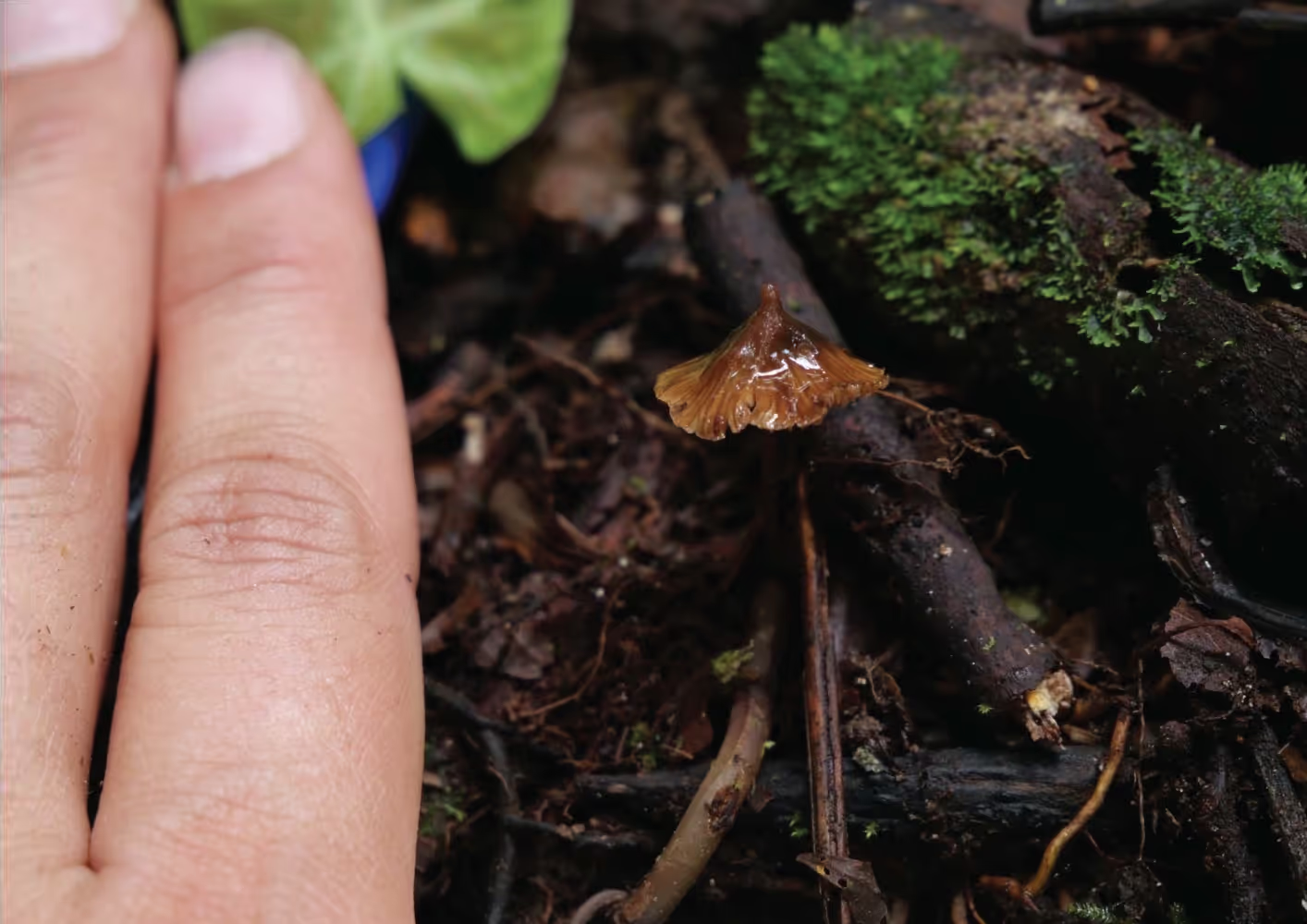
The new species, calledPsilocybe stametsiiIt was discovered in a cloud forest in Ecuador and has been collected twice: the first time in 2011 by Dr Bryn Dentinger of the University of Utah and a colleague, and then again in 2022 by the Chilean Giuliana Furci of Fundación Fungi, who was accompanied by the British author Robert Macfarlane, the musician Cosmo Sheldrake and the judge Ramiro Áila Santamaría. The fungus was found in the Los Cedros Biological Reserve, a protected area under the articles on the Rights of Nature in the Ecuadorian Constitution.
“It is an absolute joy to be able to honour Paul Stamets with a new species of fungus. His contribution to the fungi kingdom is indisputable and unparalleled, and his tireless dedication to advancing mycology has inspired thousands of people around the world for decades, myself included,” says Giuliana Furci, co-author of the new discovery.
The registration was carried out using Index Fungorum, the electronic publication tool of the Royal Botanic Gardens, Kew, which is a modern approach to speeding up species discovery by circumventing the obstacles involved in publishing in conventional scientific journals to name a single new species.
This is the first time a species has been named after Paul Stamets, and it has special significance because it is a fungus of the genusPsilocybePsilocybin produced by this type of mushroom has been used since ancient times, and is being studied and used by modern medicine for its therapeutic benefits. Stamets has devoted much of his professional life to studying this genus, publishing the book *Psilocybin Mushrooms of the World* in 1996. That year, Stamets also named a new species of…Psilocybein honour of Dr Andrew Weil*(Psilocybe weilii)*, a prominent leader in the field of natural medicine, as well as the species Psilocybe azurescensin 1995. Before that, Stamets wrote a series of books on how to cultivate gourmet and medicinal mushrooms, which to this day remain a reference when it comes to growing mushrooms.
“I feel deeply honoured by this recognition and eager to take part in a field expedition to see this species in its natural habitat,” Stamets said about the new fungus. “This kind of recognition is the greatest honour a mycologist can receive, and the fact that two renowned mycologists are co-authors of this discovery deepens my appreciation. I also feel a great responsibility to further protect the mycodiversity of fungi in all their wonderful forms. They really are fantastic!” he added.
With regard to the characteristics of the fungus, Dr Dentinger explains: "*Psilocybe stametsii*It appears to be a solitary species. It has been seen only twice, and on both occasions it was found on its own. It is no taller than a match, and like most other magic mushrooms its colours are in shades of brown, blending in with the leaves and decomposing soil where it grows. One notable characteristic is the pointed pileus, a trait shared by other close relatives. Phylogenetically, it is closer to an environmental soil DNA sequence in China and evolutionarily distinct from the other species to which it is closely related, described in Bolivia, Mexico and Puerto Rico.
.avif)
Only between 5% and 10% of the world’s fungal diversity is known, so the discovery and recording of new species is essential for establishing a useful baseline for biodiversity monitoring. In addition, new records can provide data that could benefit human and planetary wellbeing. Fungi are neither plants nor animals, and although they are rarely acknowledged, they are in fact complex organisms that form a kingdom of their own. “Many refer to macroscopic biodiversity as fauna and flora, but in reality we should all be using the three Fs: fauna, flora and funga,” the authors emphasise.


.avif)