Who was María Sabina, and how did she change history?
.avif)
FFungi Staff
Founding Director
FFungi Volunteer

María Sabina was an important healer who knew how to use hallucinogenic mushrooms to heal. She lived in Mexico. She could not read or write. Nor did she speak Spanish. She was an Indigenous Mazatec woman, and that was her language. In Mazatec, the word “book” does not exist. She did not write her story. She did not even recount it firsthand, since it was translated into Spanish for foreigners and Mexicans interested in her power and knowledge. It is important to clarify that the life of María Sabina is recounted and recorded by others. Her story—what she lived through and what she knew—belongs to a language that we neither understand nor speak.
The first mushroom ritual she attended was when one of her uncles was ill and a healer treated him. Thanks to that experience, she recognised the mushrooms while walking on a hill with her younger sister, María Ana. Impulsively, they both tried the mushrooms; they laughed, cried, and thus she began to experiment with visionary mushrooms or“The Holy Children”…as I would call *psilocybe* mushrooms.
María Sabina lived in Huautla de Jiménez, in the mountains of the Sierra of Oaxaca, in southern Mexico. Her father’s family had a tradition of healing knowledge and were considered shamans. Her father died when she was 3 years old, so her mother went out to work, and she and María Ana were left in the care of their maternal grandparents. They lived in poverty, and both had to help them with their work raising silkworms and animals, working on the plantations, and doing domestic chores.
At the age of 14, she was given in marriage to Serapio Martínez, with whom she had three children: Catarino, Viviana, and Apolonia. María Sabina often emphasised that Serapio could read and write. He joined the fight in the Mexican Revolution and, after returning some time later, he died. She was widowed after six years of marriage. In this situation she fell ill, and they say she could not move. No one knew how to cure her. She used the mushrooms as medicine, and it was revealed to her that she should worship God and, together with them, heal other people.
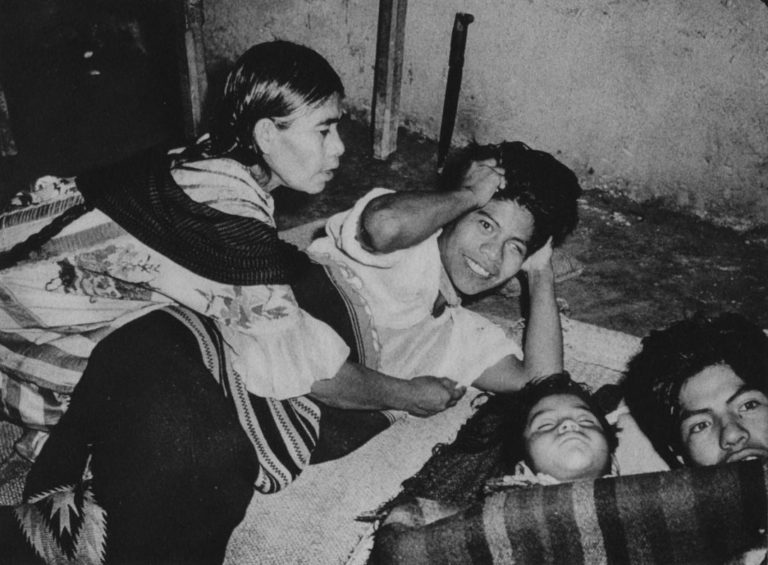
She went out to work to support her children and her mother. She was a street vendor and worked in the fields. She did some healing, but she had to set it aside, and over time she began to forget it.
After more than 10 years of mourning, Marcial Carrera appears, determined to win her over. It was said that he was a sorcerer and, although she was not very interested, she ended up marrying him. They had six children and all of them died, except for their daughter Aurora. Marcial was a drunk and cheated on her. What is more, he was violent and hit her.
Amid this difficult time for María Sabina, a crucial event occurs: her sister falls ill, and all the local healers assured everyone that she would die. María Sabina decides to hold a ceremony to try to cure her. María Ana recovers, and word quickly spreads about María Sabina’s healing abilities. But Marcial, her husband, jealous of her powers, becomes even more aggressive towards her. Until one day, his affairs with other women backfire, as the children of the lover with whom he was cheating killed him.
She is widowed again. She says that the mushrooms healed her and gave her strength during that time of abuse. Since the death of her second husband, she devoted herself entirely to healing through mushrooms and became a recognised healer in the Huautla area. She treated emotional problems, addictions, and even feuds between families.
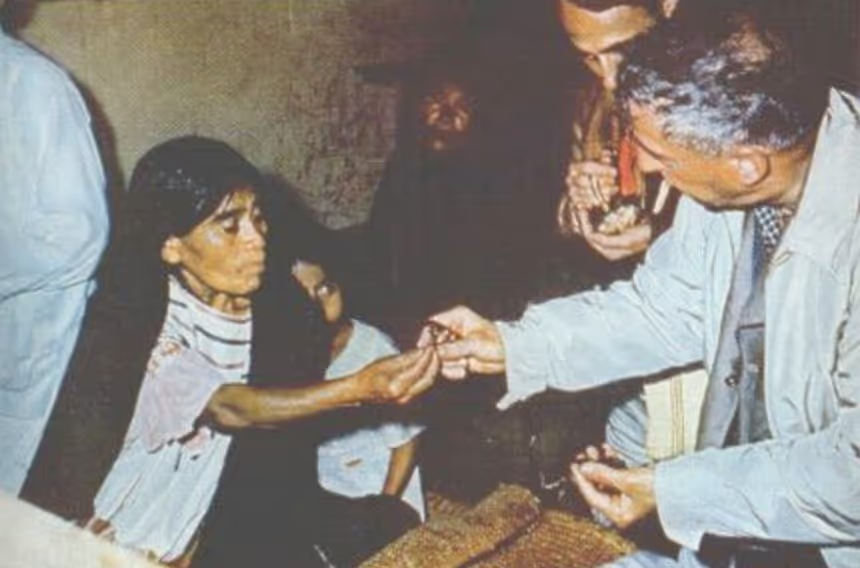
In 1955, Robert Gordon Wasson, an American banker and ethnomycologist, arrived in Huautla to meet María Sabina and her powerful mushrooms. Accompanied by the photographer Allan Richardson and a translator from the same town, they arrived at the healer’s house to take part in a ceremony with…“The Holy Children.”
The testimony and record of Wasson’s visit were published in 1957 in the*Life* magazine and it caused a great stir both scientifically and socially. To protect her identity somewhat, he changes her name to Eva Méndez. He then publishes a string of books on the subject and word spreads about María Sabina. It was the 1960s–70s and the hippie movement was at its peak. A healer who used mushrooms in Mexico was very striking news for the time.
Many foreigners arrived, and from one day to the next Huautla filled up with visitors looking for God or a transcendental experience, while others only wanted to get high. There were two cases of people who, while high on other substances, took mushrooms with María Sabina and ended up running down the hill to the town, shouting incoherently with their eyes rolled back, causing a commotion in the village.
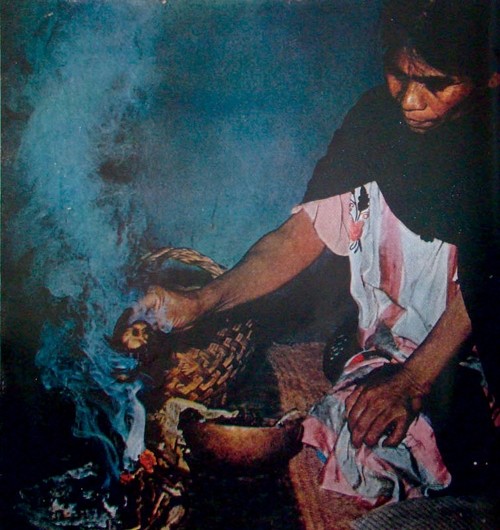
She was accused of drug use and was arrested on two occasions. When this situation became known, prominent anthropologists and international scientists contacted the President of Mexico, José Guillermo López, and asked him to release her. He agreed and María Sabina was set free. Even so, her problems with her neighbours did not end, and she was affected by robberies and they even set fire to her modest home. Despite her growing popularity and clientele, she did not charge for her healings. She received donations such as food or a little money, so her financial situation was always precarious.
It is said that among the local healers they used to say that she should not have received all those people and shared her knowledge, because that would cause her to lose her power. In fact, on one visit, Wasson shows her a disc with recordings of her chants and she gets angry, telling him that she never gave him permission to “steal her song”. Little by little, those episodes harmed her, and she herself acknowledged that the mushrooms lost their power. They began to disappear, and her health worsened. They say that by opening up all that energy she knew from the mushrooms, she lost it. Even so, thanks to her kindness, today it is possible to study different types of psilocybes and research their medicinal uses. There is also now a historical record of an unknown ancestral body of knowledge, which, thanks to the generosity of María Sabina, could be recognised and valued.
At 91, in 1985, she died of cirrhosis and pulmonary thromboembolism. The story of María Sabina is full of speculation. She lived in multiple realities and worlds, faced harsh, earthly poverty, and looked God in the eyes.
There is a poem that records some of her quotations and ends with the phrase: “I am the spirit woman, because I can enter and I can leave the realm of death.”


.avif)