Historic! Fundación Fungi celebrates the pioneering progress of the National Geographic Society
March 12, 2024

.avif)
FFungi Staff
Founding Director
FFungi Volunteer
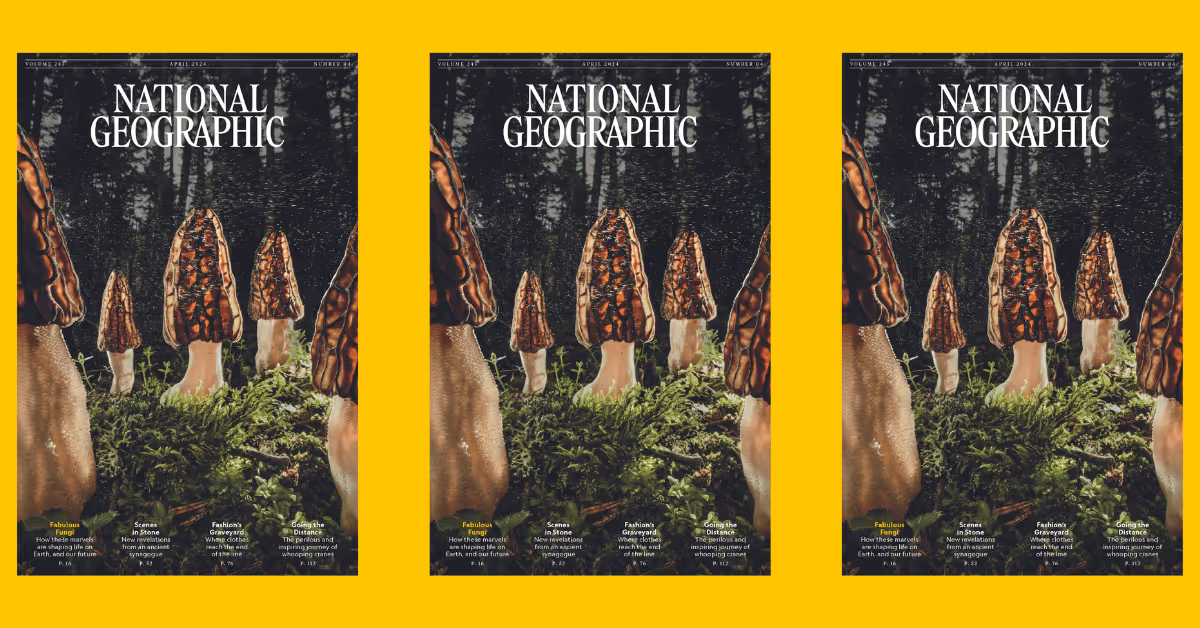
Moreover, for the first time in its more than 130-year history, a photograph of fungi is on the cover of *National Geographic* magazine.
Fungi constitute one of the kingdoms of life, a category as broad as that of “animals” or “plants”, and they play a vital role in maintaining our planet. When we disrupt them, we endanger the health and resilience of the biosphere. We also destroy the library of extraordinary solutions that fungi have developed, many of which could prove vital for human beings in the future. However, fungi have been little studied and account for a mere 0.2% of global conservation priorities.
“We applaud National Geographic’s leadership in adopting mycologically inclusive language,” said Giuliana Furci, founder and Chief Executive Officer of the Fundación Fungi and a National Geographic Explorer. “Integrating fungi into the conservation narrative deepens our understanding of ecosystems and invites us to consider our collective responsibility towards these organisms and the vital processes they control. We hope that National Geographic’s pioneering action can serve as a call to action, encouraging other institutions, organisations, national governments and individuals to recognise and prioritise the role of fungi—often overlooked—in the complex tapestry of our planet’s biodiversity and the many ways they support human life, from vital medicines to food.”
For these reasons, Fundación Fungi, a non-profit organisation founded in 2012 and currently a leader in fungal conservation, praises the recent historic decision by National Geographic Society to include the fungi kingdom in its definition of wildlife alongside plants and animals.
“Our work with wildlife now covers projects that inspire and empower local and global audiences to better understand and protect wildlife as a whole, including animals, plants and fungi,” said Ian Miller, Director of Science and Innovation at National Geographic Society.“The same threats that affect plants and animals, such as habitat destruction, climate change and overexploitation, also affect fungi. We hope that by including the fungi kingdom, current and future Explorers will know that the Society supports projects that aim to understand, shed light on and protect these critical organisms.”
Additionally, the magazineNational GeographicIt published today a historic cover and a series of articles about fungi. The April edition marks a milestone, as it is the first time in its more than 130-year history that the magazine has featured fungi as its cover story.The edition includes four distinct “chapters” on the fungi kingdom: as a danger to hitchhikers; as a potential antidote to devastating plant diseases; as key to advances in cancer research; and as a solution to the global problem of fast fashion. Also available inNatGeo.comThe reports explore the most fascinating aspects of these organisms, which are often overlooked: from building the biome of our bodies to the potential dangers of the future and the promise they represent for humanity.
“The work of the Fundación Fungi has been instrumental in helping people around the world to better understand the importance of fungi, and we couldn’t be happier that these organisms are the main subject of our cover in the April issue of National Geographic. Our hope is to show readers just how fascinating fungi are and the vital role they play in our ecosystems and in our lives,” said Nathan Lump, Editor-in-Chief of National Geographic.
National Geographic Society has spent more than 130 years leading the discovery of biodiversity and the conservation of nature. During that time, scientific advances in the fields of plant and animal sciences have dominated the research landscape and have been explicitly mentioned as areas of interest. The inclusion of fungi as an official area of interest places the**Funga**on an equal footing with flora and fauna when referring to macroscopic life on Earth.The concept FungaIt refers to “the fungi of a specific region, habitat or geological period”, and is equivalent tofloraandfaunafor plants and animals.This historic step by National Geographic Society will help to include this long-overlooked kingdom of life in agricultural and conservation policy frameworks, and to unlock crucial funding for mycological research, studies, and educational programmes.

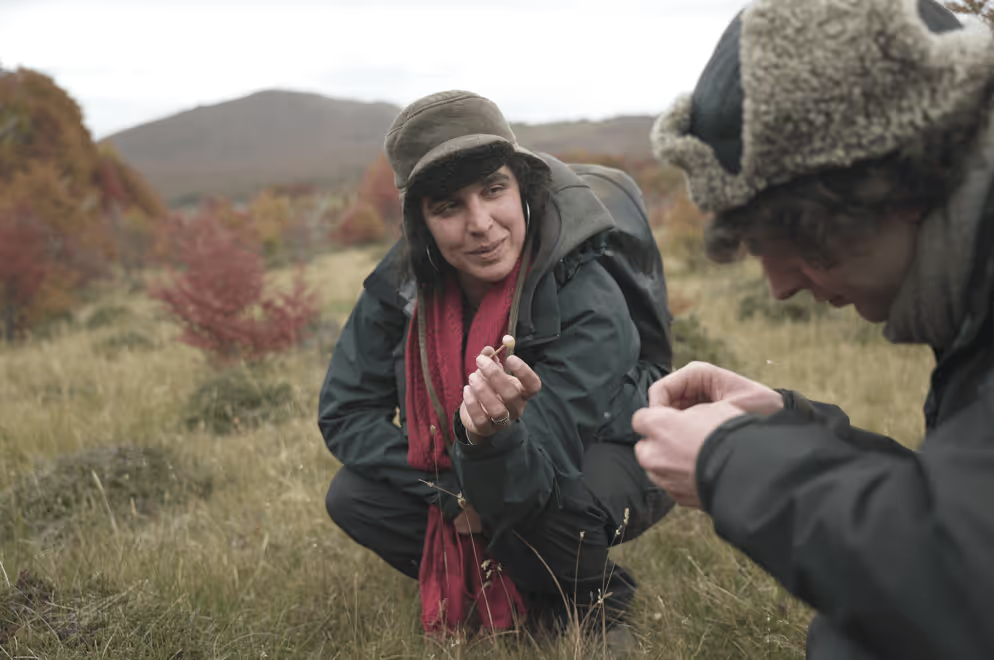
Alongside the editorial and the articles, the Impact Story Lab of the National Geographic Society, an award-winning creative lab that combines world-class storytelling with the social and behavioural sciences to drive positive change for National Geographic Explorers, has produced theshort film “Flora, Fauna, Funga”,Directed by Sam Sheline of the Society. Filmed in Tierra del Fuego, Chile, the film captures part of Giuliana’s life-long efforts to ensure that fungi are protected alongside animals and plants, and follows the fieldwork carried out by theFungi Foundationalongside his close collaboratorsMerlin Sheldrake, biologist and author of the successful book on fungi *“The Hidden Network of Life”*; Toby Kiers, co-founder of theSociety for the Protection of Underground Networks; and the musicianCosmo Sheldrake,whose compositions appear in the film. The short film is already available on the channel ofNational Geographic’s YouTubeand it will also premiere at the Environmental Film Festival in Washington (DCEFF) on 26 March 2024.
The inclusion of fungi by National Geographic Society strengthens the ongoing efforts of theFauna, Flora, Funga Initiative, led by the Fundación Fungi, theMore than Human Rights Project (MOTH) from the Faculty of Law at New York University and Merlin Sheldrake. César Rodríguez-Garavito, Professor of Law at New York University and Director of MOTH, commented that “despite their crucial role in sustaining life on Earth, fungi have long been ignored in national and international policy frameworks, with Chile being a notable exception. The initiative aims to fill this gap by advocating for the inclusion of fungi in international environmental and conservation laws, policies and language.”